

The creation of the Rioja Designation of Origin: the road to Excellence in Winemaking
Designations of Origin represent a fundamental pillar in the protection and promotion of agricultural products whose quality and uniqueness are intrinsically linked to their place of origin. Nowadays, these designations are regulated within the framework of the European Union, and in the case of wine DOs, specific regulations and categories are established.
The Birth of the Rioja Designation of Origin
In the world of wine, Designations of Origin (DO) are like passports that certify the authenticity and quality of a wine according to its geographical origin. Europe has refined this system into three main categories:
- PDO (Protected Designation of Origin): It identifies its place of origin, be it a single region or even an entire country. Here, the quality and characteristics of the wine are deeply rooted in the territory.
- PGI (Protected Geographical Indication: Similar to an origin label, it indicates where the wine comes from, although the relationship to place may be a little more flexible. However, it still ensures that the product has distinctive qualities.
- TSG (Traditional Speciality Guaranteed): This term highlights the tradition and uniqueness of the product, often linking it to traditional practices or characteristics, regardless of its geographical location.
The concept of DO dates back to the 19th century, when European winemakers banded together to protect and preserve the uniqueness and quality of their wines. At the time, similar systems were established in countries such as France (Appellation d’Origine Contrôlée – AOC) and Italy (Denominazione di Origine Controllata – DOC).
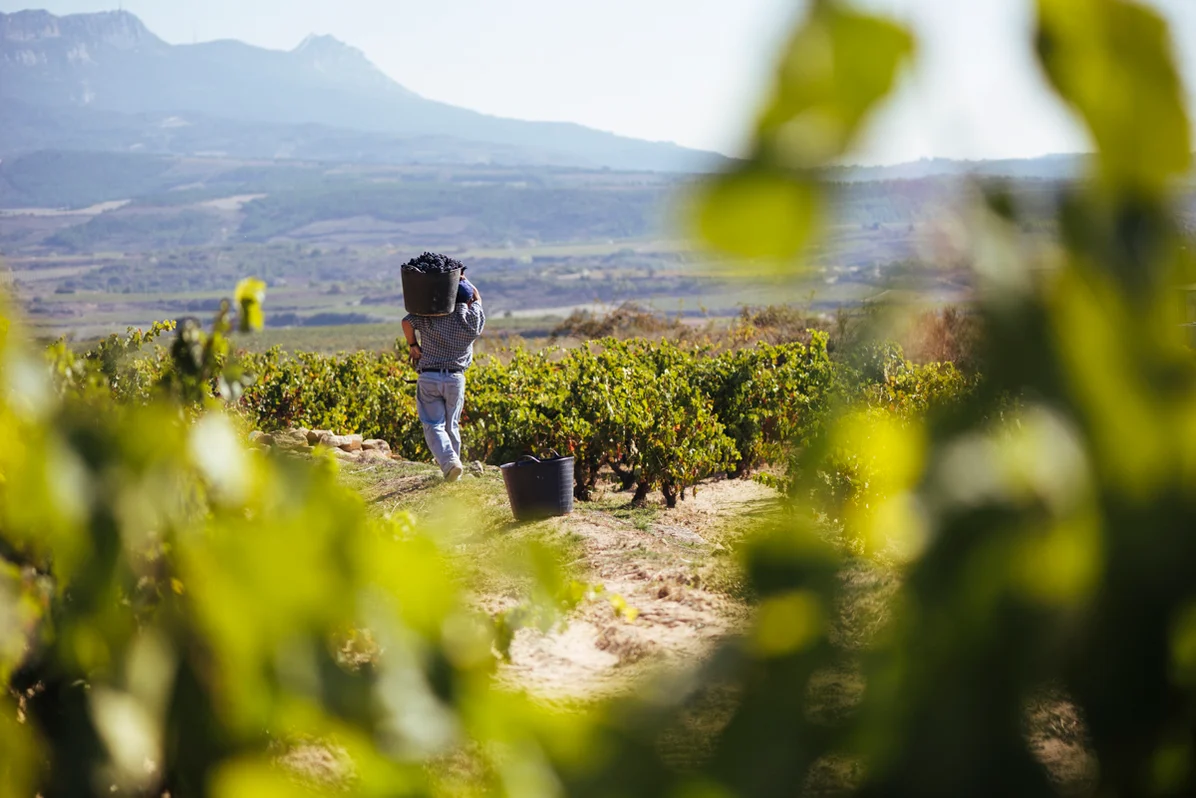
However, our story takes us to Rioja, Spain, a region that was in the midst of a wine renaissance in the early 20th century. After overcoming the devastating phylloxera plague, local producers saw the name “Rioja” gain notoriety and prestige in national and international markets. They understood the need to protect this treasure and guarantee its authenticity and quality.
In June 1925, the Spanish government gave the go-ahead for the creation of the Rioja Denomination of Origin, making it the country’s oldest DO. The first regulations defining the Rioja DO were crucial to its protection and promotion:
- Distinctive label: The inclusion of the word ‘Rioja’ on the labels created a generic brand, a signature of quality.
- Seals and back labels: These elements became the guardians of authenticity, ensuring that each bottle of Rioja was genuine.
- Geographical delimitation: A specific territory is established where the wines protected by the DO are produced.
- Legal regulations: Legal measures were implemented to prevent fraudulent use of the Rioja brand.
The Regulations of the Control Board of the Rioja Designation of Origin, approved in 1974, clearly defined the standards of quality and authenticity, covering fundamental aspects such as the delimitation of the production area, the authorised grape varieties, the cultivation practices, the minimum alcohol content, the production and ageing systems and the characteristics of the wines. A rigorous control system was also set up to guarantee the quality and authenticity of the protected products.
This journey towards excellence in winemaking culminated in 1991, when Rioja became the first region to be awarded the superior status of QDO, in recognition of its commitment to quality and constant innovation. Since then, the Rioja Denomination of Origin has served as a model for other wine regions, giving consumers the security and confidence they deserve when enjoying its exceptional wines. The history of Rioja is a living testimony to how love of wine and respect for its origins can lead to oenological excellence.

The granting of the Rioja Qualified Designation of Origin: beyond the label
The road to the Qualified Designation of Origin (QDO) is an even more demanding and rigorous one . For a wine region to achieve this privileged status, it must meet a series of extraordinary requirements that guarantee maximum quality and authenticity.
- The PDO in question must have mandatorily used the traditional term ” Denomination of Origin ” on its wines for at least 10 years.
- Wines must be bottled and marketed exclusively by wineries registered with the PDO management body and located in the defined geographical area.
- Systematic analytical and organoleptic tests are carried out on homogeneous batches of limited volume.
- Wineries registered with the PDO management body must be independent and separated, at least by a public road, from other unregistered wineries or premises.
- Wineries can only receive grapes from registered vineyards.
- The area suitable for the production of wine with the right to the Qualified Designation of Origin is delimited cartographically by municipal district.
Since its creation, the Rioja Designation of Origin has evolved and established itself as one of the most important wine regions in Spain and the world. Its focus on quality, control at source and constant innovation has contributed significantly to its success and leadership in the wine industry. The creation and development has not only been a success story for the region, but also an exemplary model for other DOs around the world, highlighting the importance of protecting and promoting the viticultural wealth of each territory.
Today ‘s regulations not only protect the quality of Rioja wines, but also ensure that each bottle tells a story of tradition, dedication and authenticity. When you enjoy a Rioja, you are tasting centuries of winemaking passion and an unwavering commitment to excellence. So, the next time you uncork a bottle of Rioja, remember that you are not only toasting to the present, but also to the rich history and exciting future of this Qualified Designation of Origin. Cheers!